

If you’ve ever asked, “How exactly does keto work in the body?” — you’re asking the right question.
After coaching 700+ Filipino clients over 10 years, I’ve noticed something important:
Most people start keto for weight loss.
Very few understand what’s actually happening inside their body.
And when you understand the mechanism — not just the meal plan — you get better results, fewer side effects, and long-term metabolic control.
In this guide, I’ll explain:
What really happens when you go below 20g net carbs
Why blood ketones ≥0.5 mmol/L matter
How insulin changes everything
Why appetite naturally drops
What labs improve (based on my real client experience)
And how keto is different from general low carb
This article is part of our deeper series on:
👉 What Is Keto — and Is It Safe?
If you’re new, read those first for foundational understanding.
Now let’s go deeper.
In my clinical practice, I define keto as:
≤ 20g net carbs per day
Blood ketone levels ≥ 0.5 mmol/L
That’s the measurable threshold.
For most Filipinos — especially those coming from rice-heavy diets — jumping straight to 20g can be overwhelming. That’s why I transition many clients gradually.
Why 20g?
Because that level reliably lowers insulin enough to shift your primary fuel source.
Which brings us to the real mechanism.
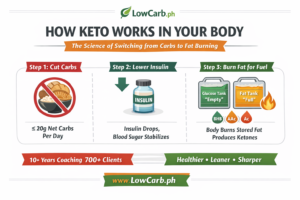
Here’s how I explain keto to clients.
Your body has two fuel tanks:
This is your quick-access tank.
But it’s small — it empties fast.
This is your long-term energy reserve.
Most people have months or even years worth of fuel stored here.
When you eat rice 3 times a day, your body keeps refilling Tank 1.
As long as glucose is available, your body will not touch stored fat.
Keto works by emptying Tank 1 consistently.
When carbs drop to 20g net:
Blood sugar stabilizes
Insulin drops
The body is forced to switch to Tank 2
The liver produces ketones from fat
This process is called nutritional ketosis.
The real driver of keto isn’t fat.
It’s insulin control.
When insulin is high:
Fat burning is blocked
Fat storage is activated
Hunger increases
Blood sugar fluctuates
When insulin drops:
Fat cells release stored energy
The liver converts fatty acids into ketones
The brain adapts to using ketones for fuel
Appetite decreases naturally
This is why keto is more than just “low carb.”
As I explain in our pillar article on low carb, keto is simply a stricter version designed to suppress insulin more aggressively.
Once carbs are restricted:
Glycogen stores deplete (24–48 hours)
Insulin decreases
Fat breakdown increases
The liver converts fatty acids into ketones
The main ketones:
Beta-hydroxybutyrate (BHB)
Acetoacetate
Acetone
In practice, I measure success by blood ketones ≥ 0.5 mmol/L.
That’s when we know the metabolic shift is happening.
One of the most consistent results among my 700+ clients:
Appetite suppression within 7–14 days.
Why?
Stable blood sugar
Lower insulin spikes
Ketones have appetite-regulating effects
Higher protein intake increases satiety
Many clients tell me:
“Coach, I’m not even trying to fast — I just don’t feel hungry.”
This is metabolic efficiency — not willpower.
In my clinical observation, here’s the typical timeline:
Carb withdrawal
Headache
Fatigue
“Keto flu”
Electrolyte loss
Water weight drop
Rapid fasting sugar improvement
Appetite reduction
Mental clarity
Stable energy
Some clients develop:
Keto rash
Muscle cramps
In 90% of cases, the cause is electrolyte imbalance.
The most common mistake?
Not enough sodium, potassium, and magnesium.
Over the past decade, here are the markers that most consistently improve:
Often drops within 3–7 days.
Noticeable improvement in 60–90 days.
Significant reduction (especially in high-carb eaters).
Often increases.
Fatty liver markers improve when insulin drops.
Often improves due to weight loss + insulin reduction.
29-year-old female, Type 2 Diabetes
Combined walking + keto (20g net carbs)
Within 60 days:
Fasting glucose normalized
Triglycerides reduced
HbA1c improved significantly
Blood pressure normalized
Fatty liver markers were slower to improve — which is common — but metabolic health dramatically shifted.
Keto works because it addresses insulin resistance directly.
After coaching hundreds of clients, these are the top problems:
Keto is not “drink butter coffee all day.”
If fat intake is excessive, the body burns dietary fat instead of body fat.
This causes:
Headaches
Fatigue
Cramps
Keto flu
Protein is critical for:
Muscle retention
Satiety
Metabolic health
Keto is moderate protein — not low protein.
This is important for your pillar strategy.
As explained in:
Low carb is a spectrum.
Keto is the stricter end of that spectrum.
| Approach | Carbs | Ketones | Goal |
|---|---|---|---|
| Low Carb | 50–100g | Not required | Blood sugar control |
| Keto | ≤20g | ≥0.5 mmol/L | Fat adaptation |
I position keto as:
A therapeutic metabolic intervention, not just a diet trend.
In my professional practice, I always advise:
Anyone with medical conditions must consult their physician before starting keto.
Especially:
Kidney disease
Advanced liver disease
Pregnancy
Underweight individuals
Those on insulin or glucose-lowering medications
Keto changes metabolism significantly.
Medication adjustments may be necessary.
In my coaching philosophy:
Keto is a metabolic repair tool.
Once:
Target weight is achieved
Blood sugar stabilizes
Insulin resistance improves
I often transition clients to moderate low carb.
This improves sustainability while maintaining results.
Metabolic flexibility is the goal — not permanent restriction.
What separates structured coaching from internet keto?
I monitor labs
I individualize macros
I adjust electrolytes
I transition rice-heavy Filipinos gradually
I combine walking + low carb
I prioritize sustainability
Keto is powerful — but only when applied correctly.
Keto works by lowering insulin enough to shift your body from burning glucose (rice) to burning stored fat — producing ketones as an alternative fuel.
That’s the metabolic switch.
If you understand this mechanism, you stop chasing:
“Fat bombs”
Trendy keto snacks
Extreme calorie restriction
Instead, you focus on:
Insulin control
Adequate protein
Electrolytes
Sustainable carbohydrate restriction
Keto isn’t magic.
It’s metabolic science.
And when done correctly — especially in a Filipino context — it can dramatically improve blood sugar, triglycerides, fatty liver markers, blood pressure, and appetite regulation.
This article is for educational purposes only and does not replace medical advice. Individuals with medical conditions or those taking medications should consult their physician before starting a ketogenic or low-carbohydrate diet.



A Researcher’s Evidence-Based Review + Real Case Data + 4-Week
The Complete Filipino Guide to Weight Loss, Hypertension Control, Diabetes
If you’ve ever tried dieting in the Philippines, you know
List of Low Carb Foods (Complete Beginner Guide for Filipinos)