
By Coach Den, nutritionist and low carb coach · Last updated: October 28, 2026
“Coach Den, how long should I stay on keto?” I get this question more than almost any other.
The honest answer depends on your goal, your metabolic condition, and how your labs respond. But after coaching 700+ Filipino clients through it, I can give you a real framework instead of a guess.
This article assumes you already know what keto is and whether it’s safe for you. If you haven’t read those yet, start with what is keto, and is it safe and how keto works in the body. Here, I’m answering one question only: when do you stop, and what do you do after?
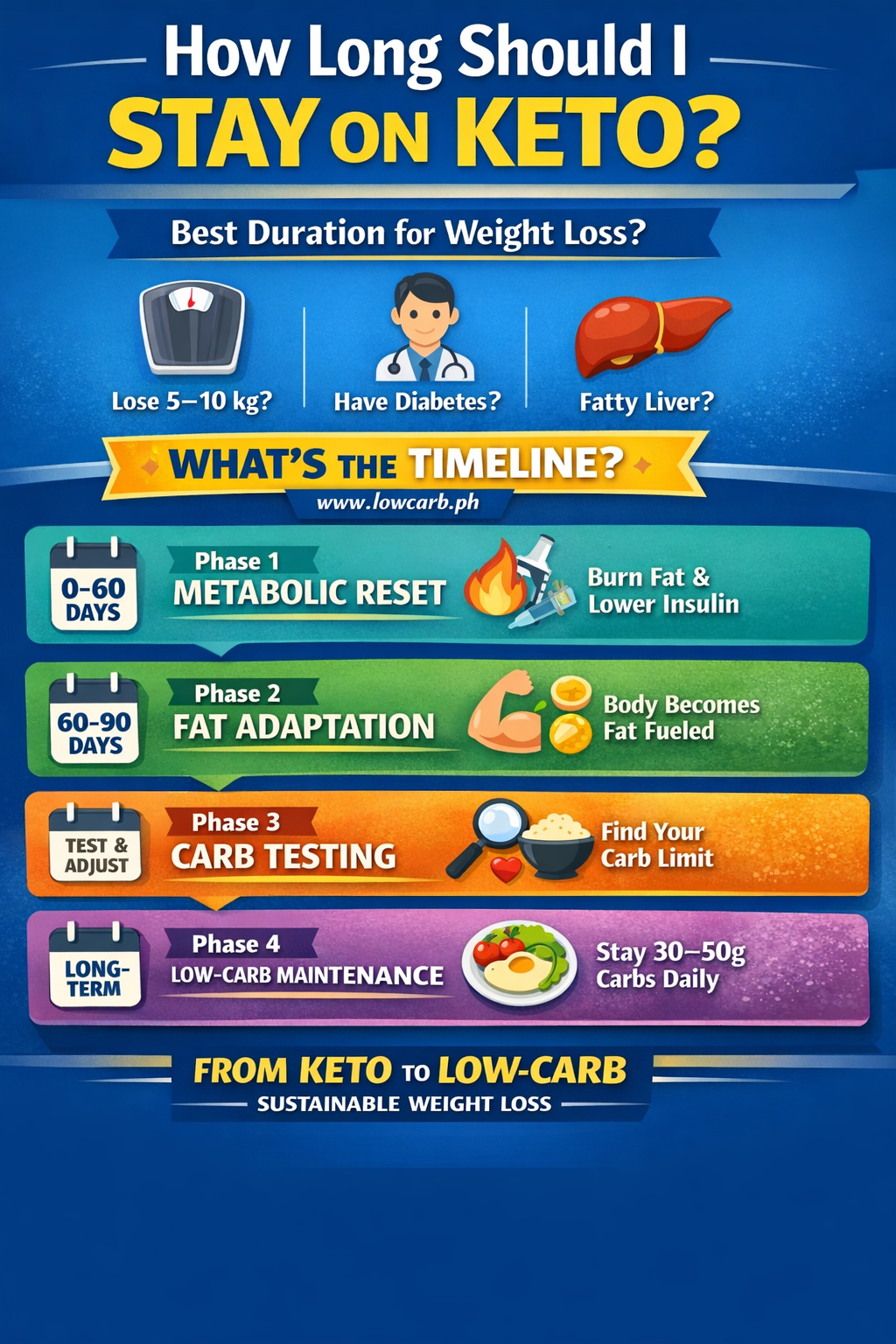
Here’s my general framework, based on goal rather than a fixed calendar date.
| Goal | Recommended strict keto duration |
|---|---|
| General weight loss (5-10 kg) | 60-90 days |
| Obesity (BMI 30+) | 3-6 months |
| Type 2 diabetes | 3-6 months minimum |
| Fatty liver | 90+ days |
| PCOS | 3-6 months |
| Metabolic syndrome | 4-6 months |
After that window closes, I move almost everyone to low carb maintenance at 30-50g net carbs a day. I don’t recommend strict keto indefinitely. Once insulin sensitivity improves, the body doesn’t need that level of restriction anymore, and holding onto it usually just makes the diet harder to sustain for no extra benefit.
Based on patterns across my client base, the timeline tends to run in stages.
Most clients drop 1 to 3 kg in the first week, along with less bloating and a flatter stomach. Some of that is water loss from glycogen depletion, but real fat mobilization starts here too. For Filipinos coming off a rice-heavy diet, this stage can feel dramatic since insulin drops fast.
This is when clients start telling me, “Coach, I’m not as hungry anymore.” Cravings fade, snacking drops, energy stabilizes, and fasting gets easier without trying. Fat loss becomes steadier during this stretch.
For clients managing type 2 diabetes, fatty liver, or high triglycerides, this is where I usually see fasting blood sugar drop, triglycerides normalize, and waist circumference shrink. I rarely recommend quitting before day 60. The real metabolic healing is just getting started at that point.
By now, the body runs on fat efficiently, hunger stays controlled, and energy holds steady through the day. This is also when I start preparing clients for the transition off strict keto.
Strict keto is a powerful short-term tool. But sustainable nutrition is what actually keeps weight off. Once the metabolic reset phase ends, I move most clients to 30-50g net carbs a day: still low enough to keep insulin down, but flexible enough to hold long-term. It’s easier socially, easier at family meals, and far more sustainable than staying at 20g forever.
A 2025 systematic review in Cureus looked at long-term outcomes for low carbohydrate diets in type 2 diabetes remission and found something worth paying attention to: remission rates were highest at the one-year mark, but dropped substantially by year five. That drop tracks with what I see in practice. Strict, rigid restriction is hard to hold onto for a decade. A version people can actually live with is what protects the results.
Keto isn’t meant to be permanent restriction. It’s meant to repair metabolic damage, then hand off to something you can live with.
One client, a woman in her late 40s managing type 2 diabetes, ran strict keto for 90 days. Her fasting blood sugar normalized, HbA1c improved, and her doctor reduced her medication. She transitioned to 30-40g net carbs afterward and has held her results since.
Another client, a 29-year-old woman combining daily walking with keto, ran strict keto for 60 days. Almost every lab normalized except her fatty liver markers, which moved slower, so I kept her on keto for 30 more days before shifting her to low carb maintenance.
A third client, an obese man with a BMI over 30, needed 6 months of structured keto. His visceral fat, blood pressure, and triglycerides all improved significantly. He transitioned to 40-50g carbs afterward and maintained the loss without rebound weight gain.
| Phase | Carbs | Goal |
|---|---|---|
| 1. Metabolic reset (0-60 days) | 20g or less | Lower insulin, start fat burning |
| 2. Deep fat adaptation (60-90 days) | 20g or less | Repair insulin resistance |
| 3. Controlled carb testing | 30-40g | Find personal carb tolerance |
| 4. Long-term maintenance | 30-50g | Prevent metabolic relapse |
Phase 1 and phase 2 use strict consistency and no cheat meals, since electrolyte management matters most here. Phase 3 slowly raises carbs while I track weight and fasting blood sugar closely. Phase 4 is the lifestyle version: flexible but structured, with an emphasis on protein and whole foods.
I don’t recommend extended strict keto for underweight individuals, pregnant women, anyone with unmanaged thyroid instability, people under heavy chronic stress, or elite athletes who need glycolytic output for performance. These groups usually do better on a structured low carb approach instead of full ketosis. I cover the fuller safety breakdown in the article linked at the top of this guide.
Most early quits trace back to the same handful of mistakes. Too much dietary fat can stall weight loss, since keto isn’t a green light for unlimited butter and bacon. Electrolyte neglect causes most of what people call “keto flu”: that’s usually a sodium, potassium, or magnesium shortfall rather than the diet itself failing. I cover exactly which minerals matter and how much in potassium and low carb diet benefits.
Unrealistic expectations cause quiet quits too. Expecting to lose 10 kg in two weeks sets almost anyone up for disappointment. And in the Philippines specifically, rice culture adds social pressure that a generic keto guide never accounts for. If skipping rice at every meal already feels like the hardest part, why people quit low carb covers the rest of the common failure points and how to plan around them.
I allow flexibility, but only once a client is past 60 days, metabolically stable, and not a poorly controlled diabetic. Even then, I structure it: one higher-carb meal, during lunch only, never dinner. Insulin sensitivity runs better earlier in the day, so a lunch carb-up affects sleep and fat storage far less than the same meal at night. I don’t recommend weekly cheat days for diabetics regardless of how stable they look on paper. If rice is the meal in question, cooling and reheating rice can blunt some of the blood sugar spike, though it’s a modifier, not a free pass.
Strict keto beyond 6 to 12 months usually isn’t necessary for weight loss alone. If someone chooses to stay strict past that window, it should be intentional, monitored by labs, and not driven by fear of eating carbs again. For most people, the arc looks like 3 to 6 months of strict keto, followed by a lifelong low carb structure. Once you’re in maintenance, foods like keto-friendly nuts and other low carb Filipino foods give you far more room to build meals around than strict keto ever allowed. We stock organic versions of a lot of these staples in our produce store, if sourcing them consistently has been the sticking point.
Keto works because it lowers insulin. But long-term success comes from insulin awareness, portion control, movement, and sustainable carb limits, not from staying in ketosis indefinitely. The goal is metabolic flexibility: a body that handles carbs reasonably well again, not one that panics at the sight of rice.
| Scenario | Duration |
|---|---|
| Minimum effective dose | 60 days |
| Optimal fat loss window | 90 days |
| Severe metabolic cases (diabetes, fatty liver, PCOS) | Up to 6 months |
| After any of the above | Transition to 30-50g low carb maintenance |
Keto is a metabolic intervention phase. Low carb is the lifestyle that comes after it. If you’re not sure which one fits where you are right now, the low carb diet guide linked below is the right place to start.
This article is for educational purposes and does not replace medical advice. If you have a medical condition, are pregnant, or take medication, talk to your doctor before starting a ketogenic or low carb diet.
About the author: Coach Den
Coach Den is a nutritionist and low carb coach based in Metro Manila who has spent 10 years helping Filipinos lower their blood sugar, lose weight, and get off the rice-and-soda cycle with food they can buy at the palengke. Read how we research and update articles in our editorial policy.
This article is for general education and is not medical advice. Talk to your doctor before changing your diet, especially if you take medicine for diabetes or blood pressure. See our medical disclaimer.