
A Clinical, Experience-Based Guide from 700+ Clients
One of the most common questions I get as a nutritionist and low carb coach is:
“Coach Den, how long should I stay on keto?”
The honest answer?
It depends on your metabolic condition, your goal, and your long-term sustainability plan.
But after working with 700+ Filipino clients over the past 10+ years, I can confidently say this:
Keto is not meant to be a punishment. It is meant to be a metabolic tool.
And like any tool, it has a purpose, a timeline, and a transition strategy.
In this guide, I’ll explain:
The ideal keto duration based on your health goal
What actually happens in the first 90 days
When to transition to low-carb
Who should NOT stay on keto
Real-world patterns I’ve seen in practice
If you’re new to this topic, I recommend reading my pillar guides first:
What Is a Low Carb Diet?
What Is Keto Diet? Is It Safe?
This article builds on those foundations.
In my clinical practice, keto means:
≤20g net carbs daily
Blood ketones ≥0.5 mmol/L (nutritional ketosis)
Whole-food based
Adequate protein
Controlled fat intake (not “fat bombs” all day)
I clearly separate:
Low-carb (30–100g carbs)
Strict keto (≤20g carbs + measurable ketosis)
Why this matters: the duration recommendation changes depending on which one you’re doing.
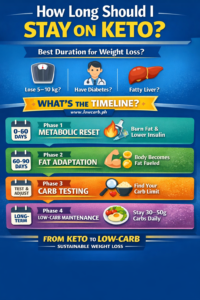
Here’s my general framework:
| Goal | Recommended Strict Keto Duration |
|---|---|
| General weight loss (5–10 kg) | 60–90 days |
| Obesity (BMI ≥30) | 3–6 months |
| Type 2 Diabetes | 3–6 months minimum |
| Fatty liver | 90+ days |
| PCOS | 3–6 months |
| Metabolic syndrome | 4–6 months |
After that?
👉 Transition to low-carb maintenance (30–50g net carbs daily).
I do NOT recommend strict keto indefinitely for most people.
Based on 700+ clients, here’s the real-world pattern I consistently see:
Many clients see:
1–3 kg drop in the first week
Reduced bloating
Flatter stomach
This is partly water loss (glycogen depletion), but also real fat mobilization begins.
For rice-heavy Filipino diets, this transition can feel dramatic because insulin levels drop quickly.
This is when people say:
“Coach, I’m not as hungry anymore.”
Cravings decrease
Snacking reduces
Energy stabilizes
Fasting becomes easier
Fat loss becomes more consistent here.
Especially in:
Type 2 diabetes
Fatty liver
High triglycerides
I regularly see:
Fasting blood sugar drop significantly
Triglycerides normalize
Waist circumference shrink noticeably
This is why I rarely recommend quitting before 60 days. The metabolic healing phase is just beginning.
By this time:
Body efficiently uses fat for fuel
Hunger is controlled
Energy is stable
Clients understand portion control
This is where we prepare for transition.
Strict keto is powerful.
But sustainable nutrition matters.
After the metabolic reset phase, I typically move clients to:
30–50g net carbs daily
Still low insulin impact
Easier socially
More flexible
Long-term sustainable
This aligns with my philosophy:
Keto is not meant to be permanent restriction. It is meant to repair metabolic damage.
Once insulin sensitivity improves, many people can tolerate slightly more carbs without regaining weight — IF they stay low-carb.
(Using patterns from my pillar case examples.)
Strict keto: 90 days
Weight loss: significant reduction
FBS: normalized
HbA1c: improved
Medications: reduced under doctor supervision
Transitioned to 30–40g carbs.
Maintained results.
Combined 10–15 min post-meal walks
Strict keto for 60 days
Almost all labs normalized except fatty liver markers
Continued keto for 30 more days.
Then transitioned to low-carb maintenance.
6 months structured keto
Significant visceral fat reduction
Blood pressure improved
Triglycerides normalized
Transitioned to 40–50g carbs.
Maintained weight without rebound.
≤20g carbs
Strict consistency
Electrolyte management
No cheat meals
Goal: lower insulin, initiate fat burning.
Continue strict keto
Improve metabolic flexibility
Stabilize hunger hormones
Goal: repair insulin resistance.
Slowly increase to 30–40g carbs
Monitor weight + fasting sugar
No ultra-processed carbs
Goal: find personal carb tolerance.
Sustainable lifestyle
Flexible but structured
Emphasis on protein and whole foods
Goal: prevent metabolic relapse.
I do NOT recommend strict keto for:
Underweight individuals
Pregnancy
Thyroid instability (especially unmanaged)
Excessive cortisol or chronic stress patterns
Elite performance athletes requiring glycolytic output
These individuals may benefit more from structured low-carb rather than strict ketosis.
Based on real coaching experience, here are the biggest mistakes:
People think keto = unlimited fat.
Excess fat can stall weight loss.
“Keto flu” is often sodium, potassium, magnesium deficiency.
Expecting 10 kg loss in 2 weeks leads to frustration.
In the Philippines, rice is emotional and cultural.
Planning matters.
I allow flexibility — but structured.
If clients are:
Past 60 days
Metabolically stable
Not diabetic or poorly controlled
I allow:
👉 Occasional higher-carb meal
👉 During lunch only
👉 Never dinner
Why lunch?
Better insulin sensitivity earlier in the day.
Less impact on sleep and fat storage.
But I do NOT recommend weekly cheat days for diabetics.
Strict keto beyond 6–12 months is not usually necessary for weight loss alone.
If someone stays strict:
It should be intentional
Monitored
Not fear-driven
For most people:
3–6 months strict keto
→ lifelong low-carb structure
Keto works because it lowers insulin.
But long-term success comes from:
Insulin awareness
Portion control
Movement
Sustainable carb limits
The real goal is not ketosis forever.
The goal is metabolic flexibility.
Here’s my clinical answer:
Minimum effective dose: 60 days
Optimal fat loss window: 90 days
Severe metabolic cases: up to 6 months
Then transition to 30–50g low-carb maintenance
Keto is a metabolic intervention phase.
Low-carb is the lifestyle.
This content is for educational purposes only and does not replace medical advice. Individuals with medical conditions, pregnancy, thyroid disorders, or those taking medications should consult their physician before making dietary changes.
If you haven’t yet, read the foundation guides:
👉 What Is Keto Diet? Is It Safe?
This article serves as a practical extension of those core concepts.



This paragraph serves as an introduction to your blog post.
This paragraph serves as an introduction to your blog post.
This paragraph serves as an introduction to your blog post.

Your personal details are strictly for our use, and you can unsubscribe at any time.
Your personal details are strictly for our use, and you can unsubscribe at any time.
Your personal details are strictly for our use, and you can unsubscribe at any time.
Your personal details are strictly for our use, and you can unsubscribe at any time.
Your personal details are strictly for our use, and you can unsubscribe at any time.
Your personal details are strictly for our use, and you can unsubscribe at any time.
Your personal details are strictly for our use, and you can unsubscribe at any time.
Your personal details are strictly for our use, and you can unsubscribe at any time.
Your personal details are strictly for our use, and you can unsubscribe at any time.
Your personal details are strictly for our use, and you can unsubscribe at any time.
Your personal details are strictly for our use, and you can unsubscribe at any time.
Your personal details are strictly for our use, and you can unsubscribe at any time.
Your personal details are strictly for our use, and you can unsubscribe at any time.
Your personal details are strictly for our use, and you can unsubscribe at any time.
Your personal details are strictly for our use, and you can unsubscribe at any time.
Your personal details are strictly for our use, and you can unsubscribe at any time.
Your personal details are strictly for our use, and you can unsubscribe at any time.
Your personal details are strictly for our use, and you can unsubscribe at any time.
Your personal details are strictly for our use, and you can unsubscribe at any time.
Your personal details are strictly for our use, and you can unsubscribe at any time.
Your personal details are strictly for our use, and you can unsubscribe at any time.
Your personal details are strictly for our use, and you can unsubscribe at any time.
Your personal details are strictly for our use, and you can unsubscribe at any time.
