
If you’ve ever searched for ways to lose weight, improve blood sugar, or lower blood pressure, you’ve probably heard the advice:
“Walk 10,000 steps a day.”
But what does that number actually do for your body?
Is it just a fitness trend — or is there real science behind it?
In my work as a nutritionist and low-carb coach, I’ve worked with 700+ clients, many of whom were struggling with obesity, type 2 diabetes, hypertension, and metabolic syndrome. One of the most powerful lifestyle strategies I consistently recommend is surprisingly simple:
Daily walking — especially after meals.
When combined with a low-carbohydrate diet, walking can dramatically improve:
weight loss
blood sugar control
blood pressure
cardiovascular health
energy levels
And the best part?
You don’t even need to start with 10,000 steps.
Beginners can start with 6,000 steps and gradually build up.

If you’re new to low-carb living, it’s helpful to first understand the metabolic foundation behind it in this guide:
👉 What Is a Low Carb Diet
That article explains why lowering carbohydrates improves insulin resistance — and why walking amplifies those benefits.
Let’s explore what 10,000 steps a day actually does inside your body.
The “10,000 steps” recommendation actually originated in Japan in the 1960s when a pedometer called “Manpo-kei” (10,000 step meter) was marketed to encourage daily activity.
Interestingly, the number was originally a marketing idea — not a strict scientific rule.
But modern research has since shown that higher daily step counts are strongly associated with better health outcomes, including:
lower risk of heart disease
improved metabolic health
better weight control
reduced mortality risk
However, studies now suggest that health benefits start much earlier — around 6,000 to 8,000 steps daily, especially for beginners.
That’s why when I coach new clients, I recommend:
Start with 6,000 steps per day and gradually add a few hundred steps until 10,000 becomes a natural routine.
Consistency matters more than hitting the perfect number.
Walking may seem simple, but the physiological effects are surprisingly powerful.
Here are some of the most important changes that occur when you consistently reach 8,000–10,000 steps daily.
One of the fastest ways walking improves metabolic health is through post-meal glucose control.
After eating carbohydrates, blood sugar rises.
When this happens:
the pancreas releases insulin
cells absorb glucose
excess glucose may be stored as fat
But walking changes this process.
When you walk, your muscles use glucose as fuel.
This allows sugar to move into muscle cells without needing as much insulin.
This is why I often recommend a 10–15 minute walk after meals, especially for people with:
prediabetes
type 2 diabetes
insulin resistance
From my experience coaching clients, even 10 minutes of walking after meals can significantly reduce sugar spikes.
For people transitioning to low carb, this strategy works extremely well alongside dietary changes.
Many people assume walking is too mild to produce meaningful fat loss.
But in reality, daily walking is one of the most sustainable fat-burning activities available.
Unlike intense workouts that people often quit after a few weeks, walking can be maintained for years.
In my coaching experience, clients combining:
Low-carb diet + daily walking
often experience faster weight loss compared to diet alone.
This happens because walking:
increases daily calorie expenditure
improves fat oxidation
lowers insulin levels
reduces stress hormones
When insulin levels fall, the body becomes better at burning stored fat.
That’s exactly what we want when following a low-carb lifestyle.
Another remarkable benefit I’ve seen repeatedly among clients is blood pressure improvement.
Many hypertensive clients who adopt:
a low-carb diet
consistent walking (close to 10,000 steps)
often experience blood pressure improvements within 2–4 weeks.
Walking helps regulate blood pressure by:
improving blood vessel elasticity
reducing arterial stiffness
improving circulation
lowering insulin resistance
Even moderate walking activates the cardiovascular system without over-stressing the body.
For people who are overweight or sedentary, walking is often the safest first step toward improving heart health.
Fatty liver disease is extremely common among people with insulin resistance.
The combination of excess carbohydrates and inactivity allows fat to accumulate in liver cells.
Walking improves this in several ways:
increases fat metabolism
reduces insulin levels
improves mitochondrial activity
promotes energy use from stored fat
While diet plays the largest role, walking accelerates recovery of metabolic health.
Many people focus only on weight loss, but daily walking also has powerful psychological benefits.
Walking increases:
endorphins
dopamine
serotonin
These neurotransmitters help improve:
mood
stress resilience
sleep quality
mental clarity
For office workers who spend long hours sitting, walking breaks can dramatically improve energy and productivity.
To illustrate the power of combining walking and low-carb nutrition, here are two real-world examples from my coaching experience.
A 29-year-old female client came to me with:
type 2 diabetes
elevated blood sugar
abnormal metabolic lab results
Her initial lifestyle included:
sedentary office work
minimal daily movement
high carbohydrate diet
We implemented two key changes:
Low-carb diet
Daily walking including post-meal walks
She began walking 10–15 minutes after meals and gradually increased daily steps.
After 60 days, the results were remarkable.
Most of her lab markers returned to normal range, including:
blood glucose
triglycerides
metabolic markers
The only issue still being addressed was fatty liver, which often takes longer to reverse.
This case highlights how simple lifestyle interventions can dramatically improve metabolic health.
Another client was a 5’1” office worker struggling with obesity.
Starting weight: 72 kg
Her daily routine involved long hours sitting at a desk.
We implemented:
low-carb diet
daily walking
post-meal movement
She used simple walking strategies like:
mall walking
after-meal walks
treadmill during TV time
After 3 months, her weight dropped from 72 kg to 55 kg.
Even more importantly, all her lab results normalized.
This shows that walking can be extremely powerful when paired with proper nutrition.
Low-carb diets improve metabolism primarily by reducing insulin levels.
When insulin drops:
fat burning increases
blood sugar stabilizes
hunger decreases
Walking enhances these effects because muscles actively use glucose and fatty acids as fuel.
This creates a powerful metabolic combination:
Lower insulin + increased energy expenditure
That’s why walking is one of the best exercises for people starting a low-carb lifestyle.
To understand this metabolic process in detail, read the full guide here:
👉 What Is a Low Carb Diet
Many beginners fail because they try to jump directly into 10,000 steps immediately.
A better strategy is gradual progression.
Week 1–2
Start with 6,000 steps daily
Week 3–4
Increase to 7,000–8,000 steps
Week 5+
Build toward 10,000 steps
The key is daily consistency, not perfection.
Walking once per week will not create the same benefits as daily moderate activity.
Walking at any time is beneficial.
But the most effective time for metabolic health is:
After meals.
A 10–15 minute walk after eating can:
reduce glucose spikes
improve digestion
stimulate circulation
increase calorie burn
For many clients, simply adding post-meal walks creates noticeable improvements in blood sugar control.
Many busy people think reaching 10,000 steps requires hours at the gym.
In reality, most steps can come from normal daily movement.
Here are the easiest strategies I recommend.
Walking after meals is the single most effective habit.
Just 10–15 minutes after lunch and dinner can already contribute thousands of steps.
Mall walking is an excellent option for:
office workers
hot climates
rainy seasons
It provides a safe, comfortable environment to walk regularly.
Many people accumulate steps by walking on a treadmill while:
watching TV
listening to podcasts
scrolling their phone
Even 20–30 minutes can add several thousand steps.
One common mistake I see is:
Walking only once a week.
Health improvements occur when walking becomes a daily habit, not an occasional activity.
Other mistakes include:
walking intensely but only once or twice weekly
staying sedentary the rest of the day
ignoring nutrition
Walking works best when combined with consistent lifestyle habits.
Interestingly, research now shows that many benefits begin around:
6,000–8,000 steps daily
But 10,000 steps remains a great long-term target because it ensures:
adequate daily movement
calorie expenditure
cardiovascular stimulation
Think of 10,000 steps as a guideline, not a strict rule.
Walking may be one of the most underrated health interventions available today.
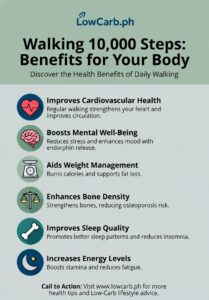
When practiced consistently, walking can help:
lower blood sugar
reduce blood pressure
accelerate fat loss
improve cardiovascular health
boost mental well-being
And when combined with a low-carbohydrate diet, the benefits become even more powerful.
If you’re just starting your metabolic health journey, I recommend first understanding the nutritional foundation explained here:
From there, begin with 6,000 daily steps, gradually building toward 10,000 steps per day.
The key is not perfection.
The key is daily consistency.
Small habits repeated every day can completely transform your health.
This article is for educational purposes only and does not replace professional medical advice. Always consult a qualified healthcare professional before making significant changes to your diet, exercise, or medication.



This paragraph serves as an introduction to your blog post.
This paragraph serves as an introduction to your blog post.
This paragraph serves as an introduction to your blog post.

Your personal details are strictly for our use, and you can unsubscribe at any time.
Your personal details are strictly for our use, and you can unsubscribe at any time.
Your personal details are strictly for our use, and you can unsubscribe at any time.
Your personal details are strictly for our use, and you can unsubscribe at any time.
Your personal details are strictly for our use, and you can unsubscribe at any time.
Your personal details are strictly for our use, and you can unsubscribe at any time.
Your personal details are strictly for our use, and you can unsubscribe at any time.
Your personal details are strictly for our use, and you can unsubscribe at any time.
Your personal details are strictly for our use, and you can unsubscribe at any time.
Your personal details are strictly for our use, and you can unsubscribe at any time.
Your personal details are strictly for our use, and you can unsubscribe at any time.
Your personal details are strictly for our use, and you can unsubscribe at any time.
Your personal details are strictly for our use, and you can unsubscribe at any time.
Your personal details are strictly for our use, and you can unsubscribe at any time.
Your personal details are strictly for our use, and you can unsubscribe at any time.
Your personal details are strictly for our use, and you can unsubscribe at any time.
Your personal details are strictly for our use, and you can unsubscribe at any time.
Your personal details are strictly for our use, and you can unsubscribe at any time.
Your personal details are strictly for our use, and you can unsubscribe at any time.
Your personal details are strictly for our use, and you can unsubscribe at any time.
Your personal details are strictly for our use, and you can unsubscribe at any time.
Your personal details are strictly for our use, and you can unsubscribe at any time.
Your personal details are strictly for our use, and you can unsubscribe at any time.
