
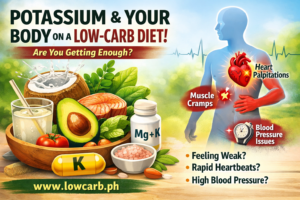
If you’ve ever started a low-carb diet and experienced:
Muscle cramps
Heart palpitations
Sudden blood pressure changes
Dizziness
Fatigue
Sugar cravings
You may not have a “carb problem.”
You may have a potassium problem.
In my 10 years working with low-carb clients in Metro Manila — including overweight patients, women with PCOS, hypertensive individuals, and type 2 diabetics — one of the most overlooked minerals I see is potassium.
And correcting it often changes everything.
Before diving deep, if you’re new to carb restriction, read my foundational guide:
👉 WHAT IS A LOW CARB DIET?
This article builds directly on that framework.
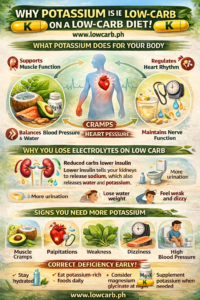
Potassium is an essential electrolyte and mineral found inside your cells. About 98% of your body’s potassium is stored within cells — especially in muscle cells.
It works closely with:
Sodium
Magnesium
Chloride
Together, they regulate:
Fluid balance
Muscle contractions
Heart rhythm
Nerve signaling
Blood pressure
Potassium is not just “for cramps.”
It is critical for survival.
Let’s break this down clearly.
Low potassium = muscles cannot contract properly.
This is why I commonly see:
Night leg cramps
Tight calves
Foot spasms
Especially during the first week of low carb.
Your heart is a muscle that depends on potassium for electrical signaling.
When potassium drops too low, patients report:
Palpitations
Fluttering sensation
Anxiety-like symptoms
I have seen this within the first 5–7 days of carb restriction.
Correcting potassium often improves symptoms within 24 hours.
Potassium helps counterbalance sodium.
Research consistently shows higher potassium intake is associated with lower blood pressure, especially in hypertensive individuals.
In my hypertensive patients:
Blood pressure gradually improves after potassium correction.
However, if a patient has pre-existing hypertension, I always advise continuing maintenance medications and consulting their physician before making any changes.
Low carb improves blood pressure.
Correct potassium improves it further.
Dizziness, weakness, fatigue — these are often electrolyte-related, not carb-related.
Many beginners blame “low carb” when the issue is improper electrolyte management.
When you reduce carbohydrates, insulin levels drop.
Lower insulin tells your kidneys to release sodium.
When sodium is released, water follows.
And when water is flushed out, potassium goes with it.
This is why during Week 1 of low carb:
You urinate more.
You lose water weight.
You may feel weak or dizzy.
You may experience cramps.
This is commonly misnamed “keto flu.”
It is actually an electrolyte shift.
Again, if you’re unfamiliar with how insulin reduction works, read:
👉 WHAT IS A LOW CARB DIET? (https://lowcarb.ph/what-is-low-carb-diet)
Over the past decade, I have observed:
Muscle cramps
Palpitations
Blood pressure fluctuations
Fatigue
Dizziness
Cycle disruption
Cravings
Many women think it’s hormonal alone.
Often, electrolyte imbalance is contributing.
Correcting potassium improves:
Energy
Cravings
Stability during carb transition
Sometimes improvement begins within Day 1.
A 38-year-old female (PCOS, overweight) started low carb.
Day 4:
Severe calf cramps
Dizziness
Sugar cravings
Instead of increasing carbs, we:
Increased potassium-rich foods
Added potassium citrate
Combined with magnesium glycinate
Result:
Improvement within 24 hours
Cravings reduced
Energy stabilized
The solution was not more rice.
It was potassium.
Started low carb for weight loss and blood sugar control.
Week 1:
BP fluctuating
Mild palpitations
We assessed:
Sodium intake
Potassium intake
Hydration
After correcting potassium intake:
Blood pressure gradually improved
Palpitations resolved
He continued his maintenance medications under physician guidance.
Electrolytes matter more than people think.
In my practice, I prefer:
Potassium citrate
Potassium gluconate
These forms generally offer 85–90% absorption.
Combining with:
Magnesium glycinate
Is often a “game changer” for cramps and sleep quality.
Food first.
Supplement only when needed.
Here’s where we get practical.
Coconut water is one of the best natural potassium sources.
I allow:
Up to 2 coconuts per day
Ideally earlier in the day
Portion control matters.
Low carb.
High potassium.
High fiber.
Excellent daily addition.
Affordable.
Accessible.
Nutrient-dense.
Easy to add to soups.
Protein + potassium.
Often overlooked source.
Bananas are famous for potassium.
But they are also high in carbs.
My approach:
Limited portion
Eat during or after lunch only
Not ideal for strict low carb
Better for moderate carb phases
For strict low carb, avocado or coconut water is preferable.
Watch for:
Muscle cramps
Palpitations
Weakness
Constipation
Fatigue
Dizziness
Blood pressure changes
These are common in Week 1.
They are preventable.
Too little potassium (hypokalemia):
Common in early carb restriction
More common in women with PCOS and hormonal imbalance
Too much potassium (hyperkalemia):
Can occur in hypertensive individuals
Especially those on ACE inhibitors or ARBs
Risk higher in kidney disease
This is why:
Do not mega-dose supplements.
Monitor labs if high-risk.
For higher-risk individuals:
Serum potassium
Sodium
Creatinine
eGFR
Magnesium
Science-backed studies show electrolyte imbalance can affect cardiovascular stability.
Particularly in:
Diabetics
Hypertensives
Kidney-compromised individuals
Monitoring matters.
Large meta-analyses show increased potassium intake is associated with:
Reduced systolic BP
Reduced stroke risk
Potassium improves sodium excretion and vascular function.
This aligns with what I see clinically.
Low carb lowers insulin.
Lower insulin reduces sodium retention.
Electrolytes must be managed intentionally.
Here’s what I advise new clients:
Increase salt slightly
Add potassium-rich foods daily
Stay hydrated
Consider magnesium glycinate at night
Add coconut water (1 serving)
Increase leafy greens
Consider potassium citrate
Assess hydration
Increase electrolytes
Consult physician if persistent
Do not quit low carb because of preventable electrolyte shifts.
In women with PCOS, I frequently observe:
Fatigue during carb transition
Cravings returning
Irregular cycle signals
Electrolyte correction often stabilizes transition.
Low carb improves insulin resistance.
But potassium helps stabilize the adaptation phase.
It’s not lack of willpower.
It’s poor electrolyte management.
Many quit within 7 days because:
They feel weak.
They feel dizzy.
They get cramps.
They think low carb is “bad.”
It’s not.
It was incomplete.
Potassium is not optional.
On a low-carb diet, it is foundational.
It:
Stabilizes muscles
Protects heart rhythm
Supports blood pressure
Prevents keto flu symptoms
Helps women transition smoothly
Supports long-term sustainability
If you’re starting low carb, don’t just remove rice.
Replace electrolytes strategically.
And always build your foundation correctly:
👉 WHAT IS A LOW CARB DIET?



This paragraph serves as an introduction to your blog post.
This paragraph serves as an introduction to your blog post.
This paragraph serves as an introduction to your blog post.

One Response