

If you are Asian — especially here in the Philippines — rice is not just food.
It is culture.
It is childhood.
It is comfort.
For many of my 700+ clients, the hardest part of transitioning to a low-carb lifestyle isn’t sugar.
It’s rice.
I constantly hear:
“Coach, di ako mabubuhay without rice.”
“I get weak without rice.”
“Di ako nabubusog pag walang rice.”
And I understand that.
Rice has been our main food while growing up. But here’s the reality: for clients with insulin resistance, prediabetes, type 2 diabetes, fatty liver, or obesity — freshly cooked rice can spike blood sugar dramatically.
So the question becomes:
Is there a smarter way to eat rice without sabotaging your metabolism?
There is a compromise strategy.
And it starts with your refrigerator.
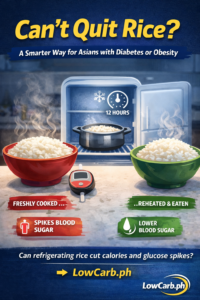
You may have seen some articles discussing research suggesting that cooling cooked rice could reduce its caloric availability by up to 50–60%.
Let’s clarify what that actually means.
The article was based on research presented by scientists in Sri Lanka showing that:
Cooking rice
Adding a small amount of fat (like coconut oil)
Cooling it for 12 hours
Then reheating it
…can increase something called resistant starch.
Resistant starch is a type of carbohydrate that resists digestion in the small intestine. Instead of being rapidly broken down into glucose, it behaves more like fiber.
That means:
Less glucose enters the bloodstream
Lower insulin spike
Fewer absorbable calories
However — and this is important for credibility — the full 50–60% reduction applies to a specific lab-prepared protocol. In real-world settings, the caloric reduction is usually smaller.
What is consistently supported in human research?
✔ Cooling rice increases resistant starch
✔ Reheating does NOT reverse the resistant starch
✔ Post-meal glucose response is lower compared to freshly cooked rice
So while I don’t promise clients a guaranteed 60% calorie reduction, I do confidently say:
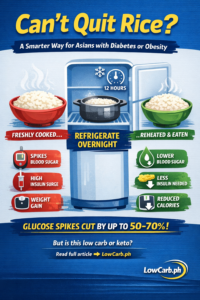
Refrigerated rice significantly lowers glucose spikes compared to newly cooked rice.
And I’ve seen it firsthand.
When rice is freshly cooked, its starch structure is gelatinized — making it highly digestible.
When you:
Cook rice
Let it cool
Refrigerate for at least 12 hours
The starch undergoes a process called retrogradation.
During retrogradation:
Some digestible starch converts into resistant starch
Digestive enzymes cannot easily break it down
Glucose release slows down
Insulin demand decreases
Organizations like the American Diabetes Association emphasize the importance of controlling post-meal glucose spikes in diabetes management.
Lowering glycemic response is one of the most powerful strategies for improving insulin sensitivity.
And that’s exactly what this rice method helps address.
This isn’t theory. This is what I’ve observed clinically.
54-year-old male
Type 2 diabetes
Using a continuous glucose monitor (CGM)
When eating freshly cooked brown rice:
Massive glucose spike
When eating refrigerated brown rice (12 hours cooled):
Glucose spike reduced by almost 70%
Same portion size.
Different metabolic response.
48-year-old male
Diabetes + obesity
Wearing a CGM
Freshly cooked white rice:
Glucose spike extremely high
Refrigerated white rice:
Spike reduced by approximately 55%
Again — same calories on paper.
But dramatically different blood sugar behavior.
This is why I call it a metabolic hack.
For clients who absolutely cannot remove rice immediately, here’s my protocol:
No need for special ingredients.
Allow steam to escape.
Minimum 12 hours for starch retrogradation.
You may:
Microwave
Steam
Stir fry
Important:
⚠️ Do NOT reheat multiple times.
Repeated heating and cooling increases food safety risks.
I use this method for:
✔ Prediabetes
✔ Type 2 diabetes
✔ Obesity
✔ Fatty liver
✔ Clients transitioning into low-carb
I do NOT recommend this for keto clients.
Even refrigerated rice is still too high in net carbs to maintain ketosis.
If you’re trying to understand the difference, read my full guide here:
👉 What Is Keto — and Is It Safe?
Let’s be clear.
Refrigerated rice is not a license to eat unlimited rice.
It is:
A transition tool
A cultural compromise
A metabolic improvement strategy
Ultimately, my goal is gradual rice reduction.
Because even with resistant starch, rice is still carbohydrate-dense.
To understand the foundation of proper carb control, read:
👉 WHAT IS LOW CARB DIET?
You don’t have to remove it overnight.
We reduce slowly.
We modify intelligently.
We retrain metabolism step by step.
Most weakness during carb reduction is actually:
Sodium deficiency
Magnesium deficiency
Psychological dependency
Energy improves once insulin stabilizes.
Satiety comes from:
Protein
Healthy fats
Fiber
Rice gives fullness by volume — not metabolic satisfaction.
When protein intake increases, hunger stabilizes naturally.
Frequent high insulin spikes lead to:
Fat storage
Insulin resistance
Fatty liver
Increased hunger
Metabolic dysfunction
The World Health Organization continues to emphasize reducing refined carbohydrate intake to lower metabolic disease risk globally.
In Asian populations with high white rice consumption, glycemic load plays a significant role in diabetes prevalence.
Lowering spike intensity — even without immediate elimination — is already progress.
As Asians, we grew up believing:
“No rice = no meal.”
But metabolic disease rates in Asia are rising rapidly.
The solution is not shame.
It’s not extremism.
It’s intelligent transition.
Refrigerated rice is not magic.
It is not keto.
It is not a miracle cure.
But for someone stuck between:
“I cannot give up rice”
and
“I need to fix my blood sugar”
…it can be the bridge.
If you cannot eliminate rice yet:
✔ Cook normally
✔ Refrigerate 12 hours
✔ Reheat once
✔ Monitor your glucose
✔ Reduce portion over time
For diabetic and insulin-resistant clients, I have seen glucose spikes drop 55–70% compared to freshly cooked rice.
That is clinically meaningful.
But remember:
This is a stepping stone.
The real long-term solution is lowering total carbohydrate load and improving insulin sensitivity — which I explain fully in:
👉 WHAT IS LOW-CARB DIET?
👉 What Is Keto Diet — and Is It Safe?
This article is for educational purposes only and does not replace individualized medical advice. Individuals with diabetes or metabolic conditions should consult their physician before making dietary changes. Continuous glucose monitoring data mentioned reflects individual case experiences and does not guarantee identical results for all readers.

A Researcher’s Evidence-Based Review + Real Case Data + 4-Week
The Complete Filipino Guide to Weight Loss, Hypertension Control, Diabetes
If you’ve ever tried dieting in the Philippines, you know
List of Low Carb Foods (Complete Beginner Guide for Filipinos)