
By Coach Den, nutritionist and low carb coach · Last updated: October 28, 2026
Water first. Black coffee second. That’s my answer whenever a client asks what they can actually drink on low carb or keto.
After coaching more than 700 clients in Metro Manila and online, I’ve watched a consistent pattern play out. Clients who drink black coffee strategically during a fasting window report less hunger, and type 2 diabetics get fewer sweet cravings. Adherence also improves, energy stabilizes, and lab markers move in the right direction once the rest of their nutrition is actually structured. But none of that happens with a caramel macchiato. So this article is about pure black coffee, and I want to walk through the actual science behind it, not just the coffee-shop version.
No, plain black coffee does not break a metabolic fast. It carries roughly 2 to 5 calories per cup, with essentially zero carbs, fat, or protein. Because of that, it doesn’t trigger a meaningful insulin response in healthy individuals. That’s exactly what matters for staying in a fasted state. For the deeper mechanism behind why insulin matters so much here, see how keto works in the body.
| What you add | Effect on your fast |
|---|---|
| Nothing (plain black) | Fast stays intact |
| Milk or creamer | Triggers an insulin response |
| Sugar or syrup | Causes a glucose spike |
| Cream in real quantity | Adds meaningful calories |
The rule I give clients is simple: if it has calories, sweetness, or dairy, it breaks your fast. So plain water, black coffee, plain tea, and electrolytes without carbs are the only things I clear during 16:8, 18:6, OMAD, or supervised extended fasting.
Autophagy is your cells’ cleanup process. Damaged proteins and worn-out cell parts get broken down and recycled, and this process ramps up during fasting, calorie restriction, and certain cellular stress signals.
Coffee contains caffeine, chlorogenic acids, and polyphenols, and all three interact with the same signaling pathways that trigger autophagy. A 2014 study in Cell Cycle gave mice coffee, then measured a clear rise in autophagy markers in liver, heart, and muscle tissue within one to four hours. Interestingly, decaf worked almost as well as regular. That tells me the effect isn’t just about caffeine, since chlorogenic acid and other compounds appear to matter too.
Here’s my honest read though: that study was done in mice, not humans. So I won’t tell you black coffee guarantees autophagy in your body the way a 48-hour fast does. Still, the mechanism is biologically plausible, and it costs you nothing to drink your morning coffee black during a fasting window instead of adding cream to it. I call it supportive, not magic.
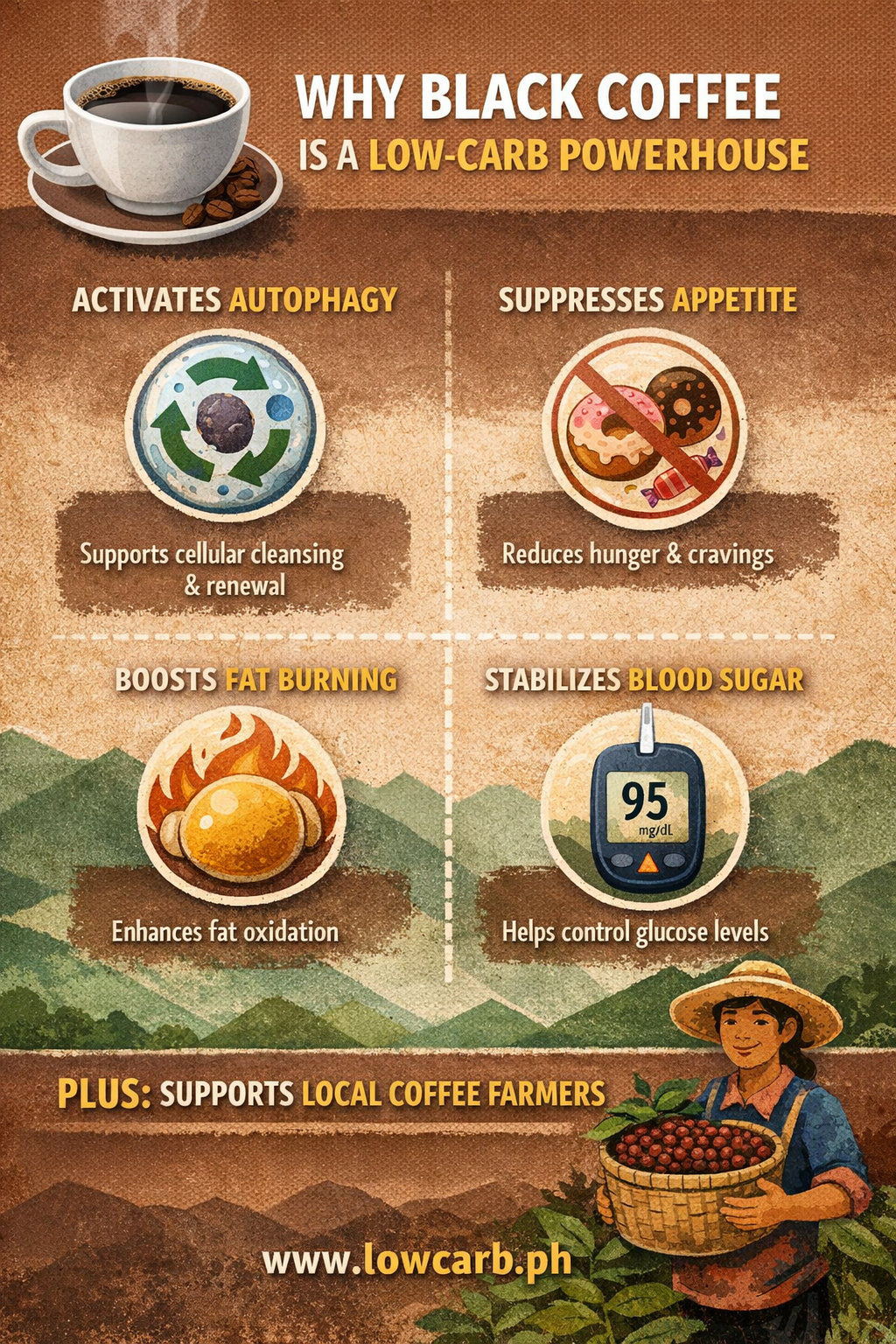
Morning hunger, sugar cravings, and midday snacking are the three things that derail new low carb clients fastest. Caffeine helps because it stimulates epinephrine release and dopamine signaling, and that combination mildly suppresses appetite while also improving focus.
In my type 2 diabetic clients specifically, black coffee during a fasting window consistently shows up alongside fewer sweet cravings and better appetite control. It also tracks with stronger adherence to their low carb structure overall. So when insulin stays low and appetite is under control at the same time, weight loss actually becomes sustainable instead of a daily fight. If cravings are still your biggest obstacle, though, my breakdown of why people quit low carb covers the other pieces of that puzzle. And my list of low carb foods that fill you up covers what to eat once the coffee window ends.
Yes, and this one has stronger human evidence than the autophagy claim. Caffeine raises catecholamines like adrenaline and noradrenaline, and those hormones stimulate lipolysis while mobilizing fatty acids for fuel. A body of exercise research, including systematic reviews pooling nearly two dozen trials, consistently finds a measurable bump in fat oxidation when caffeine is taken before exercise. The effect shows up most in people who aren’t habitual coffee drinkers.
Practically, that means black coffee works best about 30 to 45 minutes before a workout, in the morning, or during a fasting window. It’s not meant to be a background beverage you sip mindlessly all day. Think of it as a metabolic tool, not just a habit. It pairs naturally with the fat-burning shift that happens once a ketogenic diet is already dialed in.
After a decade of watching what works and what backfires, here’s what I tell almost every client.
Sleep protection is non-negotiable for metabolic health. Even a client who drinks great coffee all day but sleeps five hours a night is still fighting their own cortisol and insulin sensitivity. So the cutoff time matters more than people expect.
Caffeine can cause a temporary rise in blood pressure, especially in people who don’t drink it regularly. But in habitual drinkers, tolerance develops. As a result, long-term coffee intake hasn’t been consistently linked to hypertension in the research I follow.
In my coaching practice, I generally consider black coffee safe for clients with controlled hypertension. I do recommend taking blood pressure medication about 2 hours after coffee, though, rather than at the same time. If your blood pressure is uncontrolled, though, that’s a different conversation, and one to have with your doctor first. You can also see how the diet side of this works in can a low carb diet lower blood pressure.
Black coffee isn’t for everyone, even on low carb. So I recommend limiting or avoiding it if you have GERD, an anxiety disorder, severe insomnia, uncontrolled hypertension, or if you’re pregnant. Clinical nutrition isn’t one-size-fits-all, and coffee is one of the clearest examples of that.
Whenever it’s practical, I recommend local Barako, Benguet Arabica, or Sagada coffee over imported commercial blends. Choosing local strengthens the local economy, supports more sustainable farming, and keeps money inside Filipino agricultural communities instead of flowing out.
Health isn’t just metabolic to me, though. It’s economic and cultural too. Low carb isn’t only about restriction. It’s also about paying attention to where your food and drink actually come from, and supporting the farmers who grow it. For the full list of Filipino ingredients I build client meal plans around, see my list of low carb foods for Filipinos.
For autophagy specifically, the mouse research found decaf worked almost as well as regular coffee, which suggests compounds like chlorogenic acid play a real role. For appetite control and fat oxidation, though, those effects come mainly from caffeine, so decaf won’t do as much there.
No. Any real amount of fat or calories ends a fast, even if it doesn’t spike blood sugar the way sugar does. It may still fit inside a low carb or keto eating window, just not inside a fasting one.
I cap clients at 2 to 4 cups a day. Beyond that, most people start seeing sleep disruption, anxiety, or a jittery, wired feeling that isn’t worth whatever extra focus it provides.
No. Plain black coffee has no meaningful carbs or protein, so it won’t pull you out of ketosis. If anything, the appetite control it provides makes it easier to stay in a calorie position that supports ketosis.
Used correctly, black coffee becomes a genuine metabolic ally: fasting-compatible, appetite-controlling, and fat-oxidation-friendly. Used carelessly, with sugar, cream, or a 9 PM cup, it works against you. If you’re building out a full low carb pantry beyond just your coffee routine, our organic low carb store stocks the staples I recommend to clients.
This article is for educational purposes only and does not replace individualized medical advice. Talk to your doctor before changing your caffeine intake or fasting routine. This matters especially if you have diabetes, hypertension, heart disease, anxiety, a GI condition, or are pregnant or breastfeeding. Never stop or change a medication without medical supervision.
About the author: Coach Den
Coach Den is a nutritionist and low carb coach based in Metro Manila who has spent 10 years helping Filipinos lower their blood sugar, lose weight, and get off the rice-and-soda cycle with food they can buy at the palengke. Read how we research and update articles in our editorial policy.
This article is for general education and is not medical advice. Talk to your doctor before changing your diet, especially if you take medicine for diabetes or blood pressure. See our medical disclaimer.