
By Coach Den, nutritionist and low carb coach · Last updated: October 28, 2026
If you’ve never tried low carb before, start with what is a low carb diet first. This article assumes you already know the basics and just need the food side sorted out. It also assumes you’ve already seen my list of low carb foods for Filipinos.
This piece is for a different reader. You downloaded a 7-day plan before. Cauliflower and almond flour went into the cart. You cooked a new recipe every night. By Thursday there was no packed lunch, the fridge had four half-used ingredients, and the family pot of rice won.
You didn’t fail. The plan was written for someone who shops alone, cooks alone, and eats alone, in a kitchen with no rice cooker. That’s not a Filipino household. After 10+ years building these plans for clients in Metro Manila, here’s the actual system. Below it is the real palengke list, and the real prices behind it.
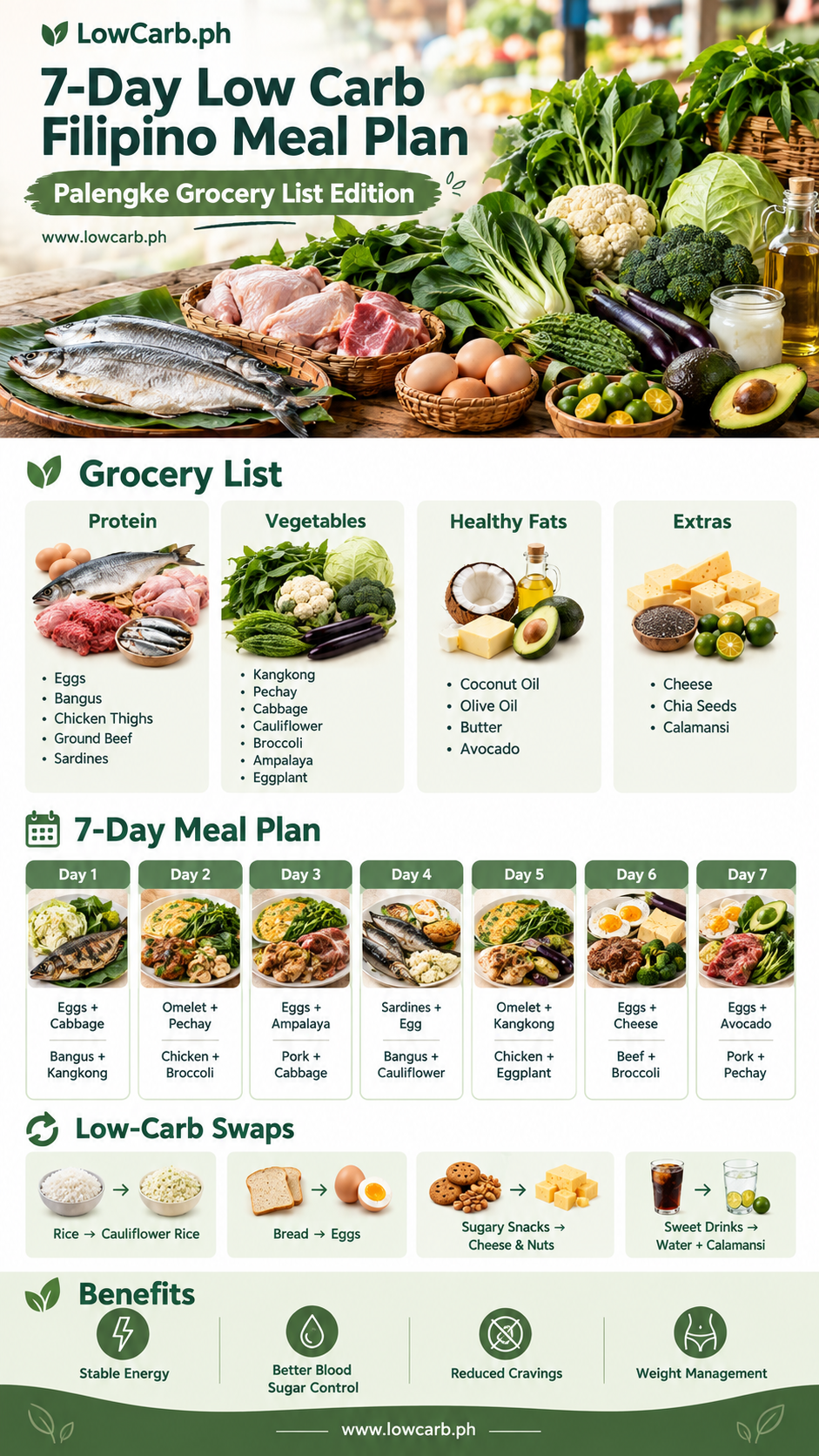
Because most of them are written for a Pinterest kitchen: a different recipe every night, imported ingredients, and a cook with nobody else to feed. A real Filipino week runs on repetition, not variety. Plans that ask for 21 unique dishes are teaching you that success means constant novelty. It doesn’t.
Success means the same three ulam existing in the fridge when you’re too tired to cook. For the deeper pattern behind why people abandon low carb around this point, see why people quit low carb.
Before I write down one ulam, I lock four things. Skip these and a 7-day plan is decoration, not a tool.
| Lock this first | What it actually means |
|---|---|
| Carb target | Standard low carb (50 to 80g) for most new clients, or a strict 20g reset for diabetes, fatty liver, PCOS with high insulin, or a client who already failed “just eat less rice” |
| Who cooks and who eats | Solo professional, a mother cooking for a rice household, or someone who only eats carinderia at lunch, this changes the plan more than macros do |
| Budget and market access | Wet market three times a week, one weekend supermarket trip, or an office cafeteria |
| Medical constraints | BP meds, metformin, gout, gallbladder issues, shift work, no pork, no dairy, this has to be clear before day one |
So most new clients start at 50 to 80g carbs a day. The strict 20g version is reserved for the group that needs it. If you’re not sure which camp you’re in, what is keto, and is it safe covers that distinction. And why diabetes is called the buy 1, take 10 disease explains why the diabetes and fatty liver group usually needs the tighter number.
Every plate is built the same way: a palm-sized protein, 1 to 2 cups of non-starchy vegetables, and a visible fat. That fat can be coconut oil, butter, olive oil, avocado, a fatty cut, or an egg yolk. There’s no default rice.
Still, if someone wants that “kanin feeling,” it’s cabbage rice, cauliflower rice, extra vegetables, or a measured 2 to 3 tablespoons of leftover rice later in the week, never on day one. For more on why volume and fat matter more than the rice itself, see low carb foods that fill you up.
| Slot | How it’s built |
|---|---|
| Breakfast | Two rotating templates only, repeated Monday through Saturday |
| Lunch | Three ulam that reheat well, not seven different dishes |
| Dinner | Three ulam, one of them soup based |
| Repeat | Same breakfasts all week, lunches and dinners rotate, never 21 unique recipes |
| Sunday | Slightly looser, still low carb, a family meal with extra protein and vegetables, skip the cake |
I rotate three to four proteins for the whole week: eggs almost daily since they’re the cheapest high-satiety food in the Philippines, chicken thighs, a fatty fish like bangus, tilapia, galunggong, or sardines, and pork or beef if the budget allows. Two or three vegetables carry the week, usually cabbage, kangkong or pechay, and whatever ampalaya, eggplant, or sitaw is cheap that week.
So one bulk vegetable gets cooked once and eaten twice. A big batch of ginisang repolyo on Sunday night covers Monday lunch and Tuesday dinner under a different protein.
There’s no scheduled merienda. If someone’s hungry between meals, it’s an egg, cheese, a few keto-friendly nuts, or leftover protein, never a snack plan of its own. A scheduled merienda is exactly how hidden carbs sneak back in.
In the first 7 days on this exact structure, eggs every breakfast, three rotating ulam, cabbage and kangkong, no default rice, one client lost 2.8 kg. He also lost an inch off his waist, and his fasting glucose fell from 7.2 to 6.1 mmol/L. By day 14 he was down 4.1 kg total, and his 3pm bread habit had quietly stopped because lunch finally held.
| Day | Weight | Waist | Fasting glucose |
|---|---|---|---|
| Day 0 | 92.4 kg | 40.5 in | 7.2 mmol/L |
| Day 3 | 90.8 kg | Not measured | 6.4 mmol/L |
| Day 7 | 89.6 kg | 39.5 in | 6.1 mmol/L |
| Day 14 | 88.3 kg | 39.0 in | 5.8 to 6.0 mmol/L |
He was a 41-year-old Makati office worker, not on any diabetes medication. He started from a high-normal lab result and a pattern of 1.5 to 2 cups of rice per meal plus sweet iced tea at lunch. His blood pressure also read lower on a repeat drugstore check around day 10, though I don’t treat one machine reading as proof of anything on its own. For what actually moves blood pressure on this kind of plan, see can a low carb diet lower blood pressure.
Here’s the part I won’t skip: week 1 weight is mostly glycogen and water, not fat. I wouldn’t call this diabetes reversal. He never had a diagnosis on medication, and 7 days isn’t reversal by any definition. The useful signal wasn’t the 2.8 kg though. It was his glucose moving down and his hunger falling while he ate adobo and tinola, not imported keto food.
He also had one headache on day 2, gone once he added real salt to his food and drank broth. That’s the electrolyte shift almost everyone hits in week one. Potassium on a low carb diet covers exactly why that happens and how to fix it fast.
Go early, walk the market in a fixed order, and buy fish before the sun wins. That’s the entire tactic. The best window is 6:00 to 7:30am, before the ice turns to slush and the kangkong wilts from sitting in water. A second, weaker window is 4:30 to 5:30pm for greens and chicken that vendors want to move before closing. I don’t send anyone for galunggong that late though, unless they’re cooking it the same night. So avoid 10am to 3pm entirely for fish, since you’ll pay morning prices for afternoon fish.
Walk wet to dry: fish first while your hands and nose are still fresh, then chicken or pork in the same cold corridor. Leafy greens come next so they don’t sit under meat juice, then cabbage and the rest of the produce, with calamansi last. Bring reusable bags, a small cooler with a frozen water bottle, and cash in small bills. Write your list with actual weights, not “konti lang,” since that’s how you go home with 300g of chicken and three dinners missing.
| What to check | Fresh signal |
|---|---|
| Bangus | Clear plump eyes, bright red gills with no sour smell, a body that springs back when pressed, a decent belly not a flat skinny fish |
| Galunggong | Clear eyes, red gills, tight scales, firm body, bought early since this fish punishes late buyers |
| Chicken (hita) | Pale pink color with skin and bone on, almost no smell, only a light drip, not a tray swimming in pink water |
Buy bangus whole, not pre-sliced in a tray. So ask the stall to debone it after you’ve already picked the fish, not before. For chicken, skip the pretty skinless fillet tray, that’s supermarket pricing wearing a palengke shirt. Ask for a whole dressed bird instead. That way, one purchase covers two days of meat plus a pot of broth from the bones.
Prices at the palengke move week to week. Cabbage alone can swing by ₱150 a kilo depending on the season, so treat these as realistic ranges from real client weeks rather than fixed numbers. For current prices in your area, the Department of Agriculture runs a live retail price watch worth bookmarking: Bantay Presyo.
| Version | Weekly cost (1 adult, Metro Manila) | What’s different |
|---|---|---|
| Tight | ₱900 to ₱1,100 | Whole chicken, bangus, tamban instead of galunggong, one cabbage, oil already at home |
| Standard | ₱1,200 to ₱1,500 | Whole chicken plus bangus plus 500g pork, two cabbages, butter |
| Comfort | ₱1,800 to ₱2,200 | Chicken thighs, boneless bangus, galunggong, plus avocado or cheese from the grocery |
That standard week was what my Makati client actually spent. It’s close to or less than what his old week cost him in rice, sweet iced tea, and a 3pm bread run. A few habits keep the bill down without cheapening the food: become a regular at one stall by week two rather than jumping around, and watch the scale instead of trusting “tingi” by piece. Swap fish by price rather than by loyalty to one name too. If galunggong is ₱320 a kilo and tamban is ₱125, take the tamban. Protein is the goal, not a specific fish.
This isn’t a four-hour meal-prep marathon. It’s about 90 minutes elapsed, 50 to 60 minutes of it hands-on. It produces two proteins, one soup base, and one bulk vegetable, using two burners running at the same time.
Fragile food like fish gets cooked the day it’s bought. Slow food like adobo and broth gets cooked Sunday since it can sit. Bitter or leafy food like ampalaya and kangkong waits for a short 25-minute Tuesday night session, since they turn watery or bitter if they sit in sauce for days.
Drinks stay simple all week: water, black coffee, and broth. If coffee is part of your morning anyway, black coffee on a low carb diet covers how to time it without breaking a fast.
The family version is the same ulam, not a second menu. Rice stays on the table for everyone else. If you cook diet food for yourself and real food for the family, you’ll be eating their food by Wednesday.
| Item | Solo week | Family week (4 people, 1 on the plan) |
|---|---|---|
| Eggs | 18 to 21 | 24 to 30 |
| Chicken | 1 whole bird | 2 birds, or 1 bird plus 1kg thighs |
| Bangus | ~1 kg | 1.5 to 2 kg |
| Cabbage | 1 to 2 heads | 3 heads |
| Kangkong or pechay | 3 bundles | 5 to 6 bundles |
| Rice | None | Whatever the household already buys, not on the plan-follower’s list |
A household version like this usually runs ₱2,200 to ₱3,000 for the week in protein and vegetables, plus the rice the family was already buying. The jump over the solo cost is almost entirely extra chicken and fish, not special diet products. Sunday cooking scales the same way: bigger pots, same 90-minute clock, packing the plan-follower’s lunch boxes first while the pot is still full.
The plating rule that actually works: one ulam, extra vegetables, rice optional per plate. Her plate gets a palm of meat, half the plate in vegetables, and no rice, or two tablespoons at most if skipping it entirely invites a 9pm raid on the rice pot. Everyone else gets the same ulam with their normal rice. The food looks like dinner for the whole table. It just looks like more vegetables on one plate.
They’re written for a person who shops alone, cooks alone, eats alone, in a kitchen without a rice cooker. Everything else is a version of that same mistake.
Western plans usually fail on the ingredients themselves. Local copycat plans usually fail on ignoring how a real household actually eats and cooks. Both fail by pretending a Filipino week looks like seven styled photos instead of one pot of adobo eaten three different ways.
Week 2 stays on the same skeleton. Changing the system because week 1 worked teaches the wrong lesson, that success means novelty, and that’s exactly how Wednesday comes back. What changes is friction, not philosophy. The shopping trip gets faster because the stalls are familiar. One disliked vegetable gets swapped for another. And the sawsawan gets cleaned up of banana ketchup and sweet chili hiding in the fridge.
| What comes back | When | Condition |
|---|---|---|
| Carinderia lunch, ordered correctly | Week 2 to 3 | Ulam plus extra vegetables, no rice, no sweet sauce |
| Cauliflower rice | Week 3+ | Only if the price is reasonable and they miss the volume, not the taste, of rice |
| Measured rice (2 to 3 tbsp) | Week 3 to 4, sometimes later | Glucose or waist still improving, treated as a test, not a default; see refrigerated rice and blood sugar if rice comes back into the picture at all |
| Loosening toward 80 to 100g carbs | After 3 to 4 solid weeks | Standard low carb clients only, not the stricter diabetes or fatty liver group |
| 16:8 fasting | Week 3 to 4 | Sleep and energy already stable, not used as a reward for surviving week one |
I use receipts, not willpower, to decide when someone’s ready to change the skeleton. That means two Sundays in a row of shopping and packing lunch without a fight, the 3pm bread run mostly gone, fish cooked the same day it’s bought, and the scale or glucose still moving the right direction even if slower than week one.
If week one only moved the scale through water loss, I don’t unlock variety yet. Week two exists to check whether the habit holds when the results get boring.
Some, mostly water and glycogen, not fat. A 2 to 4 kg drop in the first week is common and is not a fat-loss rate you should expect to continue. The number worth watching is whether hunger drops and energy holds while eating real ulam, not the scale alone.
Yes, the structure doesn’t require a wet market specifically. Pick whole chicken and whole fish over pre-cut trays where you can, since those are usually marked up the same way a palengke fillet tray is. Apply the same freshness checks at the seafood and meat counter too.
Cut the sugar gradually and lean on calamansi and vinegar for brightness instead. A squeeze of calamansi on the plate does more for a complaint about blandness than a spoon of sugar in the shared pot. It also keeps the whole household’s meal actually low carb, rather than sweetened for the kids and diet for you.
Two makes Sunday faster, but one still works. Cook the broth first since it needs the least attention, then the adobo, then finish with the fish while the other two rest. The order matters more than the burner count.
Yes. Swap pork for more chicken, fish, or shrimp if you eat seafood. Tofu also holds up well in the same ulam-style dishes: ginisang vegetables with tofu, tofu sinigang, egg and tofu together. The plate structure and the no-default-rice rule stay exactly the same.
None of this requires imported keto products or a kitchen remodel. It requires one Sunday morning, two pots, and a shopping list with real weights on it. Want the pantry staples that make this easier to repeat every week? Our organic low carb store carries the coconut oil, nuts, and spices that show up in this plan.
This article is for educational purposes only and does not replace individualized medical advice. Anyone with diabetes, kidney disease, or another medical condition should consult their physician before making significant changes to their diet. Weight, glucose, and blood pressure results mentioned reflect one client’s individual experience and don’t guarantee identical results for every reader.
About the author: Coach Den
Coach Den is a nutritionist and low carb coach based in Metro Manila who has spent 10 years helping Filipinos lower their blood sugar, lose weight, and get off the rice-and-soda cycle with food they can buy at the palengke. Read how we research and update articles in our editorial policy.
This article is for general education and is not medical advice. Talk to your doctor before changing your diet, especially if you take medicine for diabetes or blood pressure. See our medical disclaimer.